
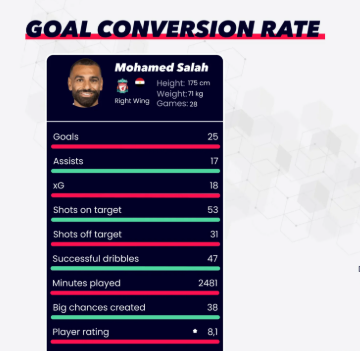
Football has a funny way of producing results that leave supporters scratching their heads. A team can dominate possession, register more shots, win numerous corners and still walk away without a point. Meanwhile, its opponent may create only a handful of opportunities and somehow secure a comfortable victory.
These situations are not always down to luck. Sometimes, the biggest difference between winning and losing comes from how effectively teams convert their scoring opportunities.
This is where goal conversion rates become important. Rather than focusing only on how many chances a team creates, this statistic examines how frequently those opportunities result in goals. It helps explain why some sides achieve impressive results with limited attacking activity while others struggle despite producing plenty of attempts.
Understanding this relationship can provide a different perspective when analysing football performances and unexpected match outcomes.
How Goal Conversion Rates Explain Surprising Football Results
1. Creating Chances Does Not Guarantee Scoring Goals
One common mistake when assessing football teams is assuming that the side creating more opportunities will automatically score more goals. In reality, football matches are decided by what happens when those opportunities arrive.
Imagine two teams playing against each other. The first records 17 shots but scores once, while the second manages only six attempts and finds the net three times.
The difference is finishing efficiency. The first team may have enjoyed greater attacking pressure, but its players failed to make enough of their opportunities count. The opponent, despite having fewer chances, demonstrated better accuracy and composure in front of goal.
This explains why total shots and goals scored do not always move in the same direction.
A team can perform well in several attacking areas but still struggle because its forwards cannot consistently turn opportunities into goals.
2. Understanding What Goal Conversion Rate Means
Goal conversion rate measures the percentage of shots that result in goals. It provides a simple way to evaluate how efficiently a team finishes its attacking attempts.
The calculation is straightforward:
Goal Conversion Rate = (Goals Scored ÷ Total Shots) × 100
For example, if a team records 12 shots and scores three goals, its conversion rate is 25%.
Another side might attempt 18 shots but score only two goals, giving it a conversion rate of approximately 11.1%.
Although the second team produced more attempts, the first was considerably more efficient. This statistic becomes particularly interesting when comparing teams that have similar attacking numbers but produce different results. It helps identify whether a side is making good use of its opportunities or regularly wasting promising situations.
However, conversion rates should be examined over several matches because a single outstanding performance can distort the overall picture.
3. Clinical Finishing Can Help Underdogs Defeat Favourite Teams
Unexpected football results often happen when an underdog makes better use of its limited opportunities. Favourite teams usually enter matches with greater expectations. They may enjoy more possession, push several players forward and create numerous attacking situations. However, these advantages mean little if their finishing is poor.
An underdog, on the other hand, might spend much of the match defending before finding opportunities through quick counterattacks.
If its forwards remain calm and take their chances, the smaller number of attempts may be enough to produce a surprising victory. This is one reason why finishing efficiency deserves attention when comparing teams of different strengths.
A club does not necessarily need to dominate a match to win it. Sometimes, taking two opportunities out of three is more valuable than creating ten chances and converting only one.
4. Poor Conversion Rates Can Expose Problems in Strong Teams
A team can have excellent attacking players and still experience disappointing results when its finishing becomes unreliable.
Forwards may rush their shots, midfielders might attempt difficult efforts from outside the box, or attackers may struggle to remain composed when one-on-one with the goalkeeper.
These problems can become particularly frustrating when a team consistently creates promising opportunities but fails to score.
Poor conversion rates may also expose weaknesses in the team's attacking decision-making. Players could be shooting when a teammate is better positioned or choosing difficult angles instead of waiting for a clearer opportunity.
When these issues continue over several matches, they can affect confidence and increase pressure on the manager. Therefore, examining conversion rates can help explain why a seemingly strong attacking team sometimes drops points against opponents it was expected to beat.
5. Goal Conversion Rates Can Reveal Differences Between Home and Away Performances
Some teams are much more effective in front of goal at home than they are when playing away. Familiar surroundings, crowd support and greater attacking confidence can influence how players approach scoring opportunities.
At home, a team may attack more aggressively and create several promising chances. Away from home, the same side might struggle to settle into the match, rush its finishing or find it difficult to deal with pressure from the opposition.
These differences can affect conversion rates. For example, a club that converts 18% of its shots at home but only 8% away may have a noticeable difference in its attacking effectiveness depending on the venue.
This information can be useful when studying upcoming fixtures. However, it is important to consider the quality of opposition, recent injuries and the number of matches used in the comparison before drawing conclusions.
6. Expected Goals Help Explain Whether Conversion Rates Are Sustainable
Goal conversion rates become even more interesting when compared with Expected Goals (xG).
Expected Goals measures the likelihood of a particular shooting opportunity resulting in a goal. It considers factors such as distance, angle, body part and the type of chance created.
A team that scores more goals than its xG suggests may have benefited from excellent finishing. Its forwards could be showing outstanding composure or producing goals from difficult positions.
However, maintaining such a high level of finishing over a long period can be difficult. Similarly, a team scoring fewer goals than its xG might be experiencing poor finishing despite creating promising opportunities.
This distinction matters because an impressive conversion rate does not always mean a team will continue scoring at the same level. Combining goal conversion rates and expected goals provides a more balanced understanding of whether a team's attacking performance is genuinely strong or temporarily benefiting from unusual finishing efficiency.
7. Defensive Quality Also Influences Conversion Rates
Although conversion rates focus on attacking efficiency, the opposition's defensive performance can influence the final figures. Some defenders are excellent at closing down shooting angles, blocking attempts and preventing attackers from getting comfortable in dangerous positions.
Goalkeepers also play an important role. A goalkeeper producing several outstanding saves can reduce an opponent's conversion rate, even when that team creates good opportunities.
This means poor finishing figures should not always be blamed entirely on attacking players. When analysing a surprising result, consider how well the winning team defended and whether its goalkeeper made important interventions.
A side that limits opponents to uncomfortable shooting positions may deserve credit for its defensive organisation rather than simply benefiting from wasted chances.
8. Why Conversion Rates Should Be Combined with Other Football Statistics
Although goal conversion rates provide valuable information, relying on them alone can lead to misleading conclusions. A team might record an unusually high conversion rate after scoring from almost every clear opportunity in one match. That does not necessarily mean it possesses a consistently superior attack.
For a more complete assessment, compare conversion rates with total shots, shots on target, shots inside the penalty area, possession and expected goals.
Recent performances are also important. A team's finishing ability can change because of injuries, tactical adjustments, player confidence and the quality of its opponents. Looking at several matches instead of one result helps separate consistent attacking quality from temporary scoring success. The aim is not simply to identify which team scores more goals but to understand how efficiently it turns its opportunities into results.
Conclusion
Unexpected football results are not always as surprising as they first appear. Sometimes, the explanation lies in the difference between creating opportunities and taking advantage of them.
Goal conversion rates help reveal how efficiently teams finish their chances, why underdogs can defeat stronger opponents and how wasteful finishing can cost favourites valuable points.
For anyone analysing football performances, this statistic offers an important reminder: dominating a match does not guarantee victory. In football, the team that makes better use of its opportunities can often have the final say.