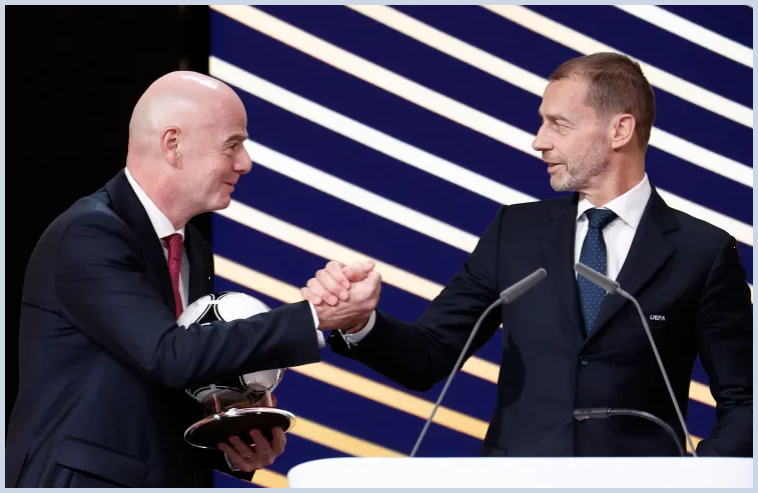
Infantino’s FIFA World Cup Investment Plan Sparks Global Backlash: Everything You Need to Know
The 2026 FIFA World Cup may have ended with Spain lifting the trophy, but football's governing body is already facing fresh controversy. FIFA President Gianni Infantino has unveiled a proposal that could reshape the business of international football by allowing private investors to buy minority stakes in future World Cups and other FIFA competitions.
While FIFA insists the move will generate more money to develop the sport globally, critics argue it risks turning football's biggest tournament into a commercial asset. The proposal has drawn strong opposition from UEFA, political leaders, and several football stakeholders.
What Is FIFA’s New Proposal?
FIFA plans to establish a commercial subsidiary known as the FIFA Forward Enterprise (FFE), valued at approximately $20 billion.
Under the proposal, FIFA would remain the majority owner, retaining control over football governance, tournament organization, scheduling, and sporting regulations. However, minority shares would be offered to private investors, with the governing body hoping to raise about $4.2 billion.
According to FIFA, the initiative is designed to unlock additional commercial opportunities while keeping football's administration under its control.
Why Does FIFA Want Private Investment?
The FIFA World Cup remains the organization's biggest source of income, generating billions through television rights, sponsorships, licensing, hospitality, and ticket sales.
During the 2026 tournament, FIFA faced widespread criticism over expensive ticket prices, with many supporters arguing that attending matches had become unaffordable for ordinary fans.
FIFA maintains that its revenues are reinvested into football development worldwide, including youth programs, grassroots football, infrastructure, and support for member associations. The new investment model is intended to increase those revenues even further.
How Would the Plan Work?
The proposal follows a model already used in several major sports competitions.
Rather than selling ownership of football itself, FIFA would create a commercial company responsible for managing the business side of tournaments. Investors would purchase minority stakes in that company while FIFA keeps overall control.
Although investors would not directly govern football, many critics believe shareholders would naturally expect influence over major commercial decisions, raising concerns about the future independence of the sport.
Who Could Invest?
FIFA has identified Thrive Eternal, a United States venture capital firm, as the lead investor for the project.
The company was founded by Joshua Kushner, brother of Jared Kushner, the son-in-law of U.S. President Donald Trump. Additional investors could join the venture by acquiring shares through the investment group if the proposal receives approval.
FIFA’s Position
Infantino believes football should benefit from its growing commercial appeal. He argues that the additional income generated through private investment would be distributed across FIFA's member associations, helping develop the sport in every region.
According to FIFA, any profits generated under the new structure would be reinvested into football rather than distributed as dividends.
UEFA Strongly Opposes the Plan
The strongest criticism has come from UEFA, Europe's football governing body.
UEFA argues that football's governance should never become subject to private commercial ownership, warning that selling stakes in the World Cup could undermine the game's integrity.
The organization questioned the transparency of the proposal and insisted that football's future should remain in the hands of its governing institutions rather than outside investors.
Political Leaders Join the Criticism
Opposition has also emerged beyond football. New United Kingdom Prime Minister Andy Burnham publicly criticized the proposal, arguing that football belongs to supporters rather than investors.
He described the FIFA World Cup as the world's greatest sporting competition and insisted it should never be treated like a commercial product available for sale.
CONCACAF Raises Concerns
The Confederation of North, Central America and Caribbean Association Football (CONCACAF) also expressed concern.
The regional governing body said it had not been consulted before FIFA announced the proposal and questioned the lack of transparency surrounding the process.
Could UEFA Boycott FIFA Competitions?
Before any changes can take effect, FIFA's 211 member associations must vote on the proposal.
UEFA represents 55 national associations, giving Europe significant influence during any vote.
The organization is expected to hold emergency discussions, and some reports suggest that a boycott of future FIFA competitions could be considered if serious concerns remain unresolved.
Given that European nations have dominated recent World Cups, any boycott would have enormous consequences for international football.
The Debate Continues
The proposal arrives shortly after a 2026 FIFA World Cup that was already surrounded by controversy. Fans criticized high ticket prices, while other debates centered on refereeing decisions and commercial practices during matches.
Now, FIFA faces another major challenge: convincing football's stakeholders that attracting private investment will strengthen rather than weaken the sport.
Whether the plan succeeds will depend on the votes of FIFA's member associations and the willingness of football's governing bodies to embrace a new commercial model.

💬 Comments (0)
No comments yet. Be the first!
Leave a Comment