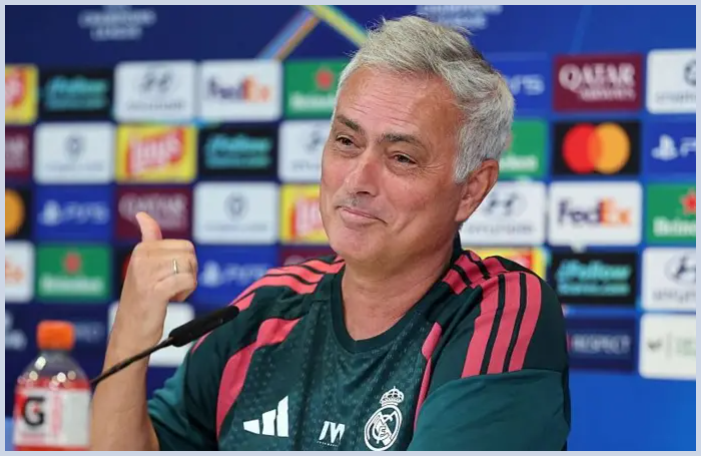
Mourinho’s Bernabéu Reunion: Can Real Madrid Conquer Europe with Inter as First Test?
José Mourinho’s return to the UEFA Champions League with Real Madrid could hardly begin with a more emotional fixture. Inter Milan, the club he guided to European glory in 2010, arrive at the Santiago Bernabéu as Mourinho starts a new attempt to take Madrid back to the summit of Europe.
A Reunion Full of History
Sixteen years ago, Mourinho stood at the Santiago Bernabéu with Inter Milan after winning the 2010 Champions League final. Inter defeated Bayern Munich 2-0, completing a historic campaign that remains one of the defining achievements of Mourinho’s career.
That success came at the end of Mourinho’s spell in Italy. Within days, he was announced as Real Madrid manager, beginning a first stint shaped by domestic success, fierce rivalry with Barcelona, and an ultimately incomplete European mission.
Now, Mourinho is back in the Real Madrid dugout, while Inter are the first opponents standing between his team and a positive start to their latest Champions League campaign. The symbolism is obvious: the club that gave him one of his greatest nights in football is now the first major test of his new Bernabéu chapter.
The European Trophy That Escaped Him
When Mourinho first arrived in Madrid in 2010, expectations were enormous. He was hired to compete with Barcelona, restore authority in La Liga, and, most importantly, deliver the club’s long-awaited 10th European Cup.
He achieved significant domestic success during that period. Real Madrid won the Copa del Rey in 2011 and the La Liga title in 2012, while the team also reached three consecutive Champions League semi-finals.
Yet, the final step proved elusive.
- Barcelona eliminated Madrid in the 2011 semi-final.
- Bayern Munich ended their run on penalties in 2012.
- Borussia Dortmund knocked them out in 2013.
Mourinho left the club in 2013 without the Champions League title Real Madrid had demanded. That absence has inevitably returned as a talking point, but the Portuguese coach insists that his earlier tenure should not be used to define his present one.
For Mourinho, this is a separate project, with a different squad, different circumstances and a new challenge: rebuilding a team that has gone two seasons without a major trophy.
Pressure Comes with the Job
At Real Madrid, success is rarely measured only by improvement. The club expects trophies, especially in Europe, and Mourinho understands that standard better than most managers.
His experience is one reason he has been trusted with another opportunity. Mourinho has handled elite dressing rooms, won major titles across several countries and lifted the Champions League twice, first with Porto in 2004, then with Inter in 2010.
Kylian Mbappé has highlighted the value of that background, pointing to Mourinho’s ability to lead a group, manage personalities and motivate players in high-pressure situations. Those traits will be vital as Real Madrid attempt to recover consistency and re-establish themselves among Europe’s strongest sides.
The challenge, however, is not only tactical. Mourinho must build stability, turn attacking dominance into goals and make sure the squad responds when results do not go their way.
Inter Provide the Ideal Test
The meeting with Inter is a demanding opening assignment. Inter enter the fixture as reigning Serie A champions, while Real Madrid approach the game after a disappointing defeat to Real Betis.
Mourinho felt Madrid created enough attacking opportunities in that loss but failed to convert their play into goals. Mbappé’s late penalty was saved, and the result underlined a familiar truth in knockout-level football: control means little if it is not matched by clinical finishing.
Mbappé has urged calm rather than panic. His focus is on helping the team respond immediately against Inter and begin the Champions League league phase with momentum.
Mourinho’s Special Bond with Inter
Mourinho’s connection with Inter remains powerful. He has made clear that he would welcome the chance to see familiar faces before and after the match, but that friendship will be set aside once the game begins. His responsibility is now to make Real Madrid win.
The fixture has also revived memories of Inter’s famous 2010 semi-final victory over Barcelona. After winning the first leg 3-1 in Milan, Inter survived an intense second leg at Camp Nou, losing 1-0 but progressing 3-2 on aggregate.
Mourinho’s celebration after the final whistle became one of the most recognisable images in Champions League history. As he ran onto the pitch to celebrate Inter’s progress, the stadium sprinklers were turned on in an apparent attempt to disrupt the celebrations. Instead, the moment only strengthened the mythology around that Inter side and its manager.
Ahead of this reunion, an Italian journalist presented Mourinho with a small garden sprinkler wrapped in a bow, an unusual but fitting reminder of the night Inter overcame Barcelona on the road to the final.
Can Mourinho Deliver Again?
One game against Inter will not decide Real Madrid’s European season. The league-phase format leaves several matches to play, and both sides will expect to compete strongly for qualification.
Still, the occasion carries greater weight than an ordinary opening fixture. It brings together Mourinho’s past, Real Madrid’s unfinished European expectations and Inter’s place in one of the coach’s most celebrated achievements.
For Mourinho, the task is clear: turn experience into progress, restore belief after a difficult period and build a Real Madrid side capable of thriving under Champions League pressure. The Inter match may not provide a final answer, but it is the perfect stage for him to show that his second spell in Spain can produce a different ending.

💬 Comments (0)
No comments yet. Be the first!
Leave a Comment