Football betting markets come in different forms, and understanding how each option works can make a significant difference when analysing a match. While many football followers are familiar with the traditional home win, draw and away win markets, other options offer different ways of approaching a fixture. One example is the Draw No Bet (DNB) market, which removes the possibility of losing a selection simply because the match ends in a draw.
For someone who regularly follows football, this market can appear straightforward. However, understanding its settlement rules, potential returns and limitations requires more than knowing that a draw results in a refund. Real match situations make it easier to understand how the market operates and why its conditions matter.
Understanding Draw No Bet Markets Through Real Football Match Scenarios helps explain how this option works, when it may be relevant and why it should not automatically be considered a safer choice.
What Exactly Is the Draw No Bet Market?
Draw No Bet is a football betting market that allows someone to select either the home team or the away team to win a match. The major difference between this option and the traditional 1X2 market is what happens when both teams finish with the same number of goals.
In a standard match-result market, there are three possible selections:
- Home team to win.
- Draw.
- Away team to win.
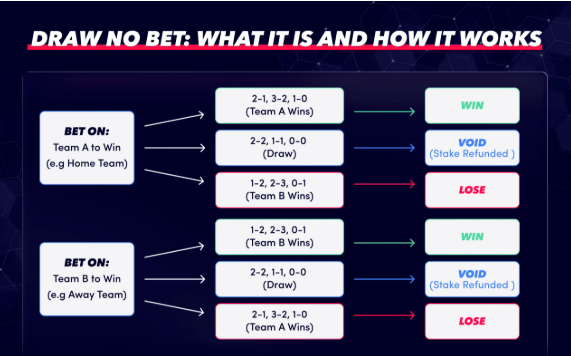
With Draw No Bet, the draw is effectively removed as a losing outcome for either team selection. If the chosen team wins, the selection is successful. If the match ends in a draw, the original stake is returned. If the selected team loses, the stake is lost.
This makes DNB particularly interesting in fixtures where one team appears stronger but a draw remains a realistic possibility.
Understanding Draw No Bet Markets
Scenario One: A Strong Home Team Faces a Difficult Opponent
Imagine Manchester City playing against a well-organised mid-table Premier League side at the Etihad Stadium. City have enjoyed good home performances, created numerous scoring opportunities and generally controlled their recent matches. However, their opponents have a disciplined defence and have drawn several games against stronger clubs.
Someone considering the home team through the Draw No Bet market has three possible settlement outcomes.
- Manchester City win 2-0: The selection wins.
- Manchester City draw 1-1: The original stake is returned.
- Manchester City lose 0-1: The selection loses.
This example demonstrates why DNB can be attractive when a team is considered the stronger side but the possibility of a draw cannot be ignored. Rather than needing a victory to avoid losing the stake, the selected team can finish level and the stake is refunded.
Scenario Two: An Away Team Faces a Difficult Stadium
Consider a situation where Arsenal travel to face Newcastle United at St James' Park. Arsenal might have a stronger overall squad and better league position, but Newcastle's home support, physical approach and attacking intensity could make the fixture difficult.
Selecting Arsenal to win through the traditional away-win market requires an outright victory. However, choosing Arsenal Draw No Bet changes the settlement conditions.
If Arsenal win 2-1, the selection wins. If the match finishes 1-1, the stake is returned. If Newcastle win 2-0, the selection loses. This scenario highlights an important point: DNB does not remove the difficulty of an away fixture. It simply changes how a drawn result affects the selection.
Analysing away form, defensive organisation, injuries and previous performances remains important before assessing the market.
Scenario Three: A Competitive Match Between Two Similar Teams
Not every football fixture has an obvious favourite. Sometimes two teams have similar strengths, comparable recent records and enough attacking quality to trouble each other.
Imagine Liverpool facing Tottenham in a fixture where both sides have demonstrated inconsistent defensive performances. A supporter who believes Liverpool have a slight advantage might consider the home team through Draw No Bet rather than the ordinary home-win market.
Suppose Liverpool win 3-2. The selection wins. If both teams finish 2-2, the stake is refunded. However, a 1-2 Tottenham victory means the selection loses.
The important consideration here is that DNB does not make an evenly matched contest predictable. It only provides a different settlement arrangement. When the gap between two teams is small, the price offered by the bookmaker becomes particularly important.
How Draw No Bet Odds and Returns Work
Understanding the odds is another essential part of interpreting this market.
DNB odds are generally lower than the corresponding outright win odds because the draw is treated as a refund rather than a losing result.
Consider a hypothetical example where a bookmaker offers the following prices for a team:
- Home win: 1.80
- Home Draw No Bet: 1.50
If someone stakes ₦10,000 on the home team at 1.50 DNB and the team wins, the total return is ₦15,000, including the original stake. The profit is ₦5,000.
If the match ends in a draw, the ₦10,000 stake is returned. If the selected team loses, the entire stake is lost. These figures are illustrative, not current bookmaker odds.
The lower price reflects the different settlement conditions. However, a lower price does not automatically mean a better decision. It is still necessary to consider whether the potential return reasonably reflects the actual possibility of the selected team winning.
Important Statistics to Examine Before Understanding DNB Markets
Real football scenarios become more useful when supported by relevant performance information. Several statistics can help explain whether a team has a convincing advantage.
· Recent form: Examine the team's latest results, but consider the quality of previous opponents rather than counting victories alone.
· Home and away records: A team may perform exceptionally well at home but struggle when travelling. This difference can influence how a fixture should be assessed.
· Head-to-head results: Previous meetings can reveal interesting patterns, although old results should not outweigh current performances and squad changes.
· Goals scored and conceded: Consistent scoring and defensive stability can provide clues about a team's overall condition.
· Injuries and suspensions: Missing key defenders, midfielders or attackers can affect the balance of a team and change the expected difficulty of a fixture.
Looking at these details provides a stronger foundation than choosing a team simply because it has a higher league position.
Common Mistakes to Avoid When Considering Draw No Bet
One major mistake is treating DNB as a guaranteed safety option. Although the draw becomes a refund, a defeat still results in the loss of the entire stake. Another mistake is ignoring the odds. A team might have a reasonable chance of winning, but an extremely low price may offer limited value compared with the risk involved.
Some people also confuse Draw No Bet with the double chance market. They are different options. Home or away Draw No Bet provides a refund when the match is drawn, while double chance covers two of the three possible match outcomes.
It is also important to check the bookmaker's settlement rules. Most standard pre-match DNB markets apply to the result after 90 minutes plus stoppage time, excluding extra time and penalties. However, competition-specific and other market rules should always be checked.
Conclusion
Understanding Draw No Bet Markets Through Real Football Match Scenarios makes it easier to see why this option attracts attention in football betting. It offers a different approach to match-result markets by returning the stake when the selected team draws, while still requiring that team to win to generate a profit.
From strong home favourites to difficult away fixtures and closely contested encounters, the examples demonstrate how the market works under different circumstances.
The most important lesson is that Draw No Bet changes the settlement conditions, not the unpredictability of football. Careful examination of team form, match statistics, squad availability and available odds remains essential. No betting market guarantees a successful outcome, and any stake carries a financial risk.
A proper understanding of the market helps football followers recognise what they are selecting rather than making assumptions based on the name alone.